
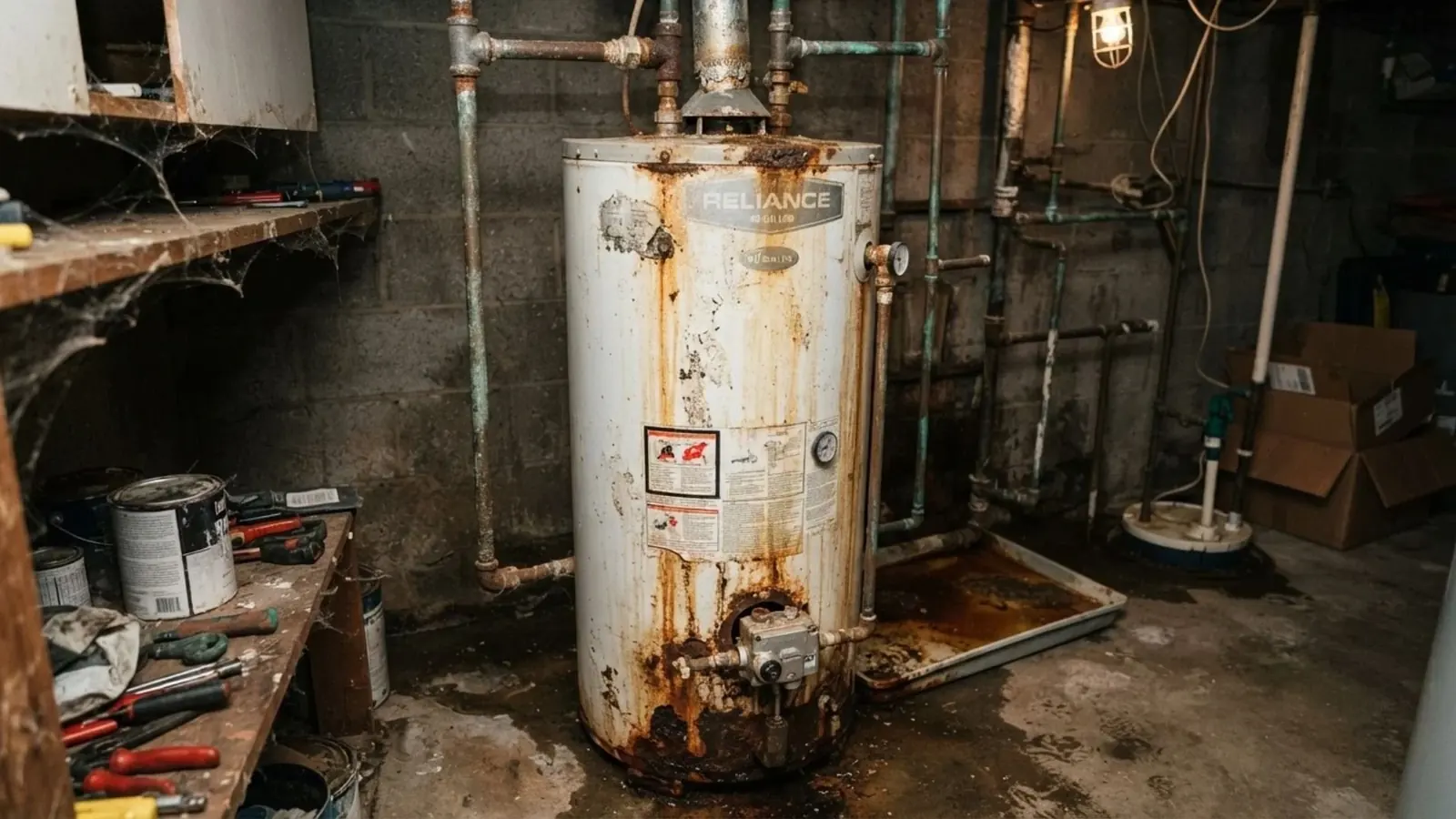
Stop the water first
Do these in order.
Close the cold water valve
Find the valve on the pipe above the tank and turn it clockwise. This stops new water from entering.
Turn off the power
For an electric unit, switch off the breaker. For a gas unit, set the control to off. If you smell gas, leave the building and call 911 and your gas utility.
Open a hot tap
Open a hot faucet upstairs to relieve pressure.
Contain the water
Place towels or a pan, and protect nearby belongings.
Where leaks come from
The source decides the fix.
| Location | Likely cause | Repair or replace |
|---|---|---|
| Top fittings | Loose or corroded connections | Usually repair |
| Relief valve or discharge pipe | Excess pressure, temperature or a worn valve | Repair, check expansion tank |
| Drain valve at the bottom | Worn valve or sediment | Repair |
| Tank base or seams | Corroded tank | Replace the heater |
| Condensation on a cold tank | Humidity, not a leak | Wipe and monitor |
Water heater leaking now?
Call (385) 488-1892 and we will get there as soon as we can.
Tank leaks cannot be repaired
Inside a storage tank, a glass lining protects the steel from the water. Over time the lining cracks and the steel corrodes, and an anode rod that sacrificed itself can no longer protect the tank. When water seeps from the shell or the bottom, the tank has failed.
No patch will last. See water heater replacement for emergency swaps and water heater installation for planning a new unit. If a flooded floor is the result, ask about drying it quickly.
Utah winters and leaks
Springville has a January mean low near 22 degrees Fahrenheit. A water heater in an unheated garage or crawl space faces cold, and supply fittings can contract and leak at joints. Hard freezes can also crack pipes near the heater. Insulate exposed hot and cold lines and check them after a cold snap.
The city's Water Division, 801-489-2740, does not list hardness, so test your tap if scale is a worry. Scale on the tank floor can overheat the lower element or cause a rumbling noise, and both shorten the life of the tank.
The relief valve discharge pipe
The temperature and pressure relief valve opens when pressure or temperature gets too high and sends water down a discharge pipe. A drip here can mean the valve is worn, but it can also mean thermal expansion is raising pressure. In a closed system, an expansion tank absorbs that pressure rise.
Do not cap or plug the discharge pipe. A relief valve that cannot discharge is a safety hazard. If it drips often, call a plumber to check the expansion tank and the incoming pressure.
Water damage and what to do next
Move belongings away from wet areas. Mop and run fans. If drywall or carpet is soaked, dry it quickly, since mold can start within a day or two. If water reached outlets or appliances, keep power off in those areas until an electrician checks.
Take photographs for your insurance company. We do not handle insurance claims, but a clear record helps your discussion with your adjuster.
Why tanks fail
Every tank heater ages. Heat cycles flex the steel, minerals settle on the bottom, and the sacrificial anode rod, a metal rod designed to corrode first, wears away. Once it is gone, the tank steel starts to corrode, and eventually a pinhole opens.
Warning signs include rusty hot water, rumbling noises, moisture at the base and water that no longer gets hot. If your heater is old and showing these signs, a planned replacement beats an emergency at midnight. Replacing the anode rod on a younger tank can extend its life, but only before the tank itself corrodes.
Replacing smart: choices to think about
A replacement is also a chance to review size, fuel and placement. A drain pan with a pipe to a floor drain protects the floor. An expansion tank protects the system from pressure rise. A shutoff valve above the heater and a drain valve that works make service easier.
Our tankless service page covers on demand units, which have no tank to leak. They do need gas and venting changes, so talk through the tradeoffs before deciding.
Checking the expansion tank
Many homes with a pressure reducing valve or a check valve at the main have a small expansion tank near the water heater. Tap it. The top should sound hollow and the bottom should sound solid. If the whole tank sounds solid, the air bladder may have failed, which lets pressure spike and can make the relief valve drip.
Short term steps while you wait
If the leak is slow and you must wait for a repair visit, keep the water shutoff closed and drain the tank to reduce pressure on the leak. Use hot water only after the tank refills and the leak is fixed. Keep children and pets away from the area, and do not run the heater while empty, since elements burn out when dry.
Permits for the swap
The city's published permit information does not say whether a water heater swap needs a permit. Call the Building Division at 801-489-2704 to ask. Gas lines are inspected through the City Inspect portal with 24 hours of notice.
Serving nearby towns
We dispatch to Spanish Fork and Salem as well as Springville, so a leaking tank anywhere in our area can get help the same day when available.
Code and permit note
Under the International Plumbing Code (IPC), a relief valve discharge pipe must not be capped or plugged, and Utah applies the IPC with statewide amendments.
Common questions
Water can damage floors and electrical items, and hot water can scald. Shut off the water and power first.
No. A leak from the tank shell means the tank has failed.
It may be worn, or pressure may be rising from thermal expansion. A plumber can check.
Do not wait. Close the water and power and call for a repair or replacement.
Yes. Our 24/7 line is open for water heater emergencies. See water heater repair.