
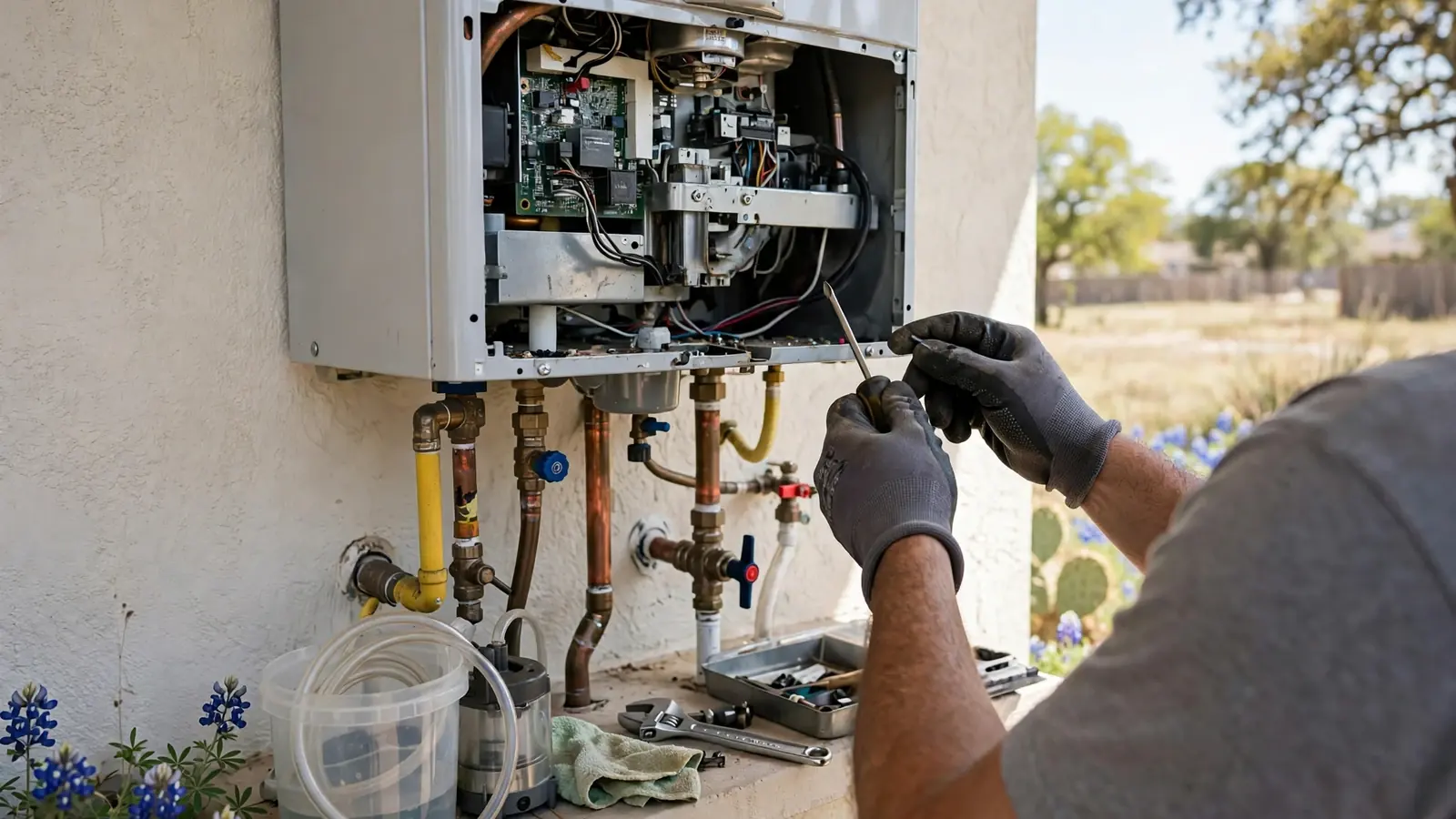
How a tankless water heater works
When a hot tap opens, flow sensors fire a burner or energize elements that heat water as it passes through a heat exchanger. When the tap closes, the unit shuts off. There is no stored volume, so you will not run out as long as the unit can keep up with the flow.
The limit is flow rate. If several showers and a dishwasher run at once, a unit sized too small cannot raise the temperature enough. We size the unit to your fixtures and your incoming water temperature.
Tankless or tank: how to decide
Both are reasonable. The right answer depends on the house.
Tankless suits
- Homes that want endless hot water for normal use
- Spaces where wall mounting saves floor area
- Households wanting lower standby heat loss
- Owners who will schedule yearly flushes
A tank suits
- Homes with limited gas or electric capacity
- Lower upfront budget
- Simple like for like replacement
- Households with very large simultaneous demand
Installation steps
Tankless installation involves more than hanging a box on a wall.
Check supply
We check gas line size, meter capacity and venting, or the electrical service for electric models.
Mount and vent
We mount the unit, install a proper vent and connect water with service valves for flushing.
Gas and electrical
We upsize gas piping or add a circuit where needed.
Commission
We test combustion, set the temperature and check flow and error codes.
Thinking about tankless?
Call (385) 488-1892 and we will check whether your home suits one.
Is tankless worth it for your household?
The honest answer depends on use. Tankless units save the standby heat a tank loses all day, so households with modest hot water use and good gas capacity tend to benefit most. Households with heavy simultaneous demand may need two units or a larger one.
Installation cost is higher than a like for like tank swap because gas lines, venting and sometimes electrical service change. We give the full picture before you decide, including the yearly flush, so there are no surprises later.
Flushing and descaling
Minerals coat the heat exchanger over time and reduce performance. Most manufacturers call for a yearly flush with a descaling solution, more often where water is hard. The unit needs isolation valves so the flush can run, and we install those on new units.
Springville's city report lists total dissolved solids between 240 and 476 ppm for 2024 but no hardness figure. Test your own tap or ask the Water Division at 801-489-2740, then set your flush schedule accordingly.
Common tankless problems
Most faults are signaled by an error code. Write it down before calling.
| Symptom | Likely cause | Fix |
|---|---|---|
| Cold water bursts | Scale on the heat exchanger or flow sensor | Flush and descale |
| Error code shows | Venting, ignition or sensor fault | Diagnose by code, replace part |
| Not enough hot water | Unit undersized or supply restricted | Check flow and supply, resize |
| Unit shuts off | Low flow or blocked vent | Clear filters and vents |
What affects the cost
Tankless work involves the unit and the supply.
Call (385) 488-1892 for your price.
Code and permit note
Code note: tankless units follow the maker's instructions and the International Plumbing Code (IPC), and gas piping changes are inspected by the city.
Common questions
Most makers say once a year, and more often with hard water. If you are unsure of your water, test it.
In many homes, yes. It depends on gas or electric capacity and venting, which we check during a visit.
Yes. We service common brands and diagnose by error code. See also water heater repair for tank units.
Not in the way a tank can, but a unit sized too small will not keep up with many fixtures at once.
Yes. We dispatch to Mapleton, Spanish Fork, Salem and Provo.