
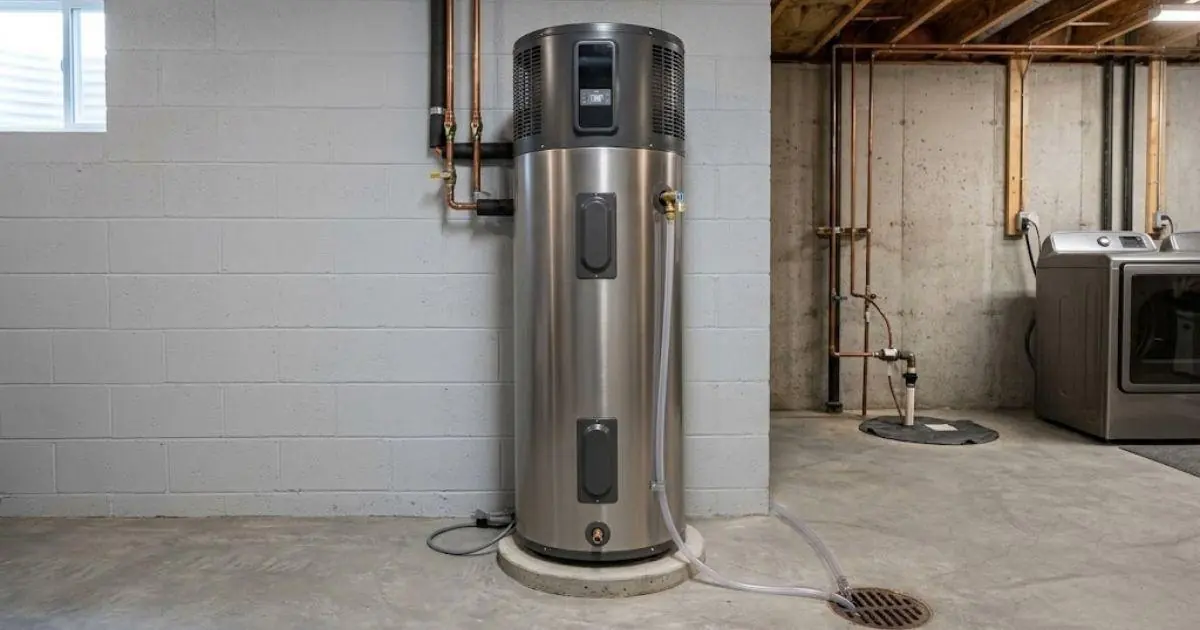
How a heat pump water heater works
A heat pump unit has a tank like any other, plus a compressor and fan on top. The compressor moves heat from room air into the water, much as a refrigerator moves heat out of its box. Most models also include electric heating elements as a backup for heavy demand.
Because it moves heat instead of making it, the unit can use far less electricity than a resistance heater. It also cools and dries the air near it, which can be welcome in a warm utility room and unwelcome in a cold one.
What the unit needs
These needs decide whether a location works.
| Need | Why | What to check |
|---|---|---|
| Air volume | The unit pulls heat from surrounding air | Follow the manufacturer minimum for room size or provide ducting |
| Condensate drain | The unit produces water as it cools air | A floor drain or pump nearby |
| Clearance | Fan and filter need room for airflow and service | Space above and around the unit |
| Electrical | Most need a dedicated circuit | Panel space and wiring |
| Temperature | Efficiency drops when air is very cold | A space that stays above freezing |
Springville winters and where the unit sits
Springville sits at about 4,554 feet, and January brings a mean low near 22 degrees Fahrenheit and a mean high near 40, according to climate records. An unheated garage in that climate gets cold enough to cut a heat pump unit's efficiency and, at times, to freeze condensate lines.
A conditioned basement or interior utility room is a safer choice. If the only space is a garage, ask about models rated for lower temperatures and plan for the drain line to stay frost free.
Thinking about a heat pump unit?
Call (385) 488-1892 and we will check your space and your options.
How an installation goes
Installation is similar to a standard electric swap with a few additions.
Check the space
We measure room volume, find the drain and check the panel.
Set and connect
We set the unit, connect water, install a relief valve and run the condensate line.
Electrical
We connect the circuit and confirm it matches the model.
Commission
We start the unit, check modes and show you the controls.
Compared with tank and tankless
Standard electric tanks are simple and cheap to buy. Heat pump units cost more up front and use less power. Tankless units save space and heat on demand but need strong gas or electrical service.
For gas homes, a gas tank or tankless unit is often the easier match. For all electric homes with space, a heat pump model deserves a look. Our water heater installation page and tankless service page explain the other options.
Maintenance and noise
The fan and compressor make some noise, about like a dehumidifier, so avoid walls shared with bedrooms. Clean the air filter as the maker directs, and flush the tank on a schedule, especially if your tap tests hard. The city report does not list hardness, so test your tap or ask the Water Division at 801-489-2740.
Permits and the Building Division
The city's published information does not say whether a water heater swap needs a permit. Call the Building Division at 801-489-2704 and ask. The city schedules inspections through its City Inspect portal with 24 hours of notice.
Sizing and recovery
Heat pump units heat water more slowly than gas or standard electric elements, so many models have modes that switch on the backup elements for heavy demand. In that mode they use more electricity but recover faster. Ask about the unit's first hour rating, which tells you how much hot water it can deliver starting with a full tank.
Households with large soaking tubs or many people showering in the morning should choose a larger tank. Households of one or two can use a smaller one. Your plumber should size it to your real pattern, not to the number of bedrooms alone.
Common problems and what they mean
A heat pump unit that runs its fan but heats slowly may have a dirty air filter or a blocked coil. A unit that shows a drain or condensate error needs a clear drain line, because a clogged line can overflow. If the unit trips its breaker, call for diagnosis rather than resetting it again and again.
Noise changes also matter. A new rattle can mean a loose panel or a failing fan. A hiss or a clicking sound from the tank during heating can be mineral scale on the lower element, and a flush may help. If you also see water at the base, the tank itself may be leaking, which means replacement. See water heater replacement.
Questions to ask any installer
Ask where the condensate will drain and whether you need a pump. Ask how much air space the model needs and whether your room meets it. Ask what the winter performance looks like for your location, and ask for the first hour rating of the model they propose.
Ask who handles the electrical connection and whether a permit applies. Springville's published information does not address water heater permits, so the Building Division at 801-489-2704 is the place to confirm. A clear answer to each question before work starts is a good sign.
Nearby towns
Homes in Provo and Salem face similar choices. Newer homes there often have good basement space for these units.
Code and permit note
The International Plumbing Code (IPC) still requires a relief valve and discharge pipe on a heat pump unit, just as on a standard tank.
Common questions
It can, but cold winter nights reduce efficiency and risk freezing the condensate line. A heated space is better.
Yes. The unit produces condensate. A floor drain, a drain line or a small pump handles it.
It cools and dries nearby air, which is helpful in a warm room and a drawback in a cold one.
Yes, with electrical work and a plan for the old vent. We assess it on a visit.
Call and tell us the make and model. We will tell you what we can do. For standard tanks see water heater repair.