
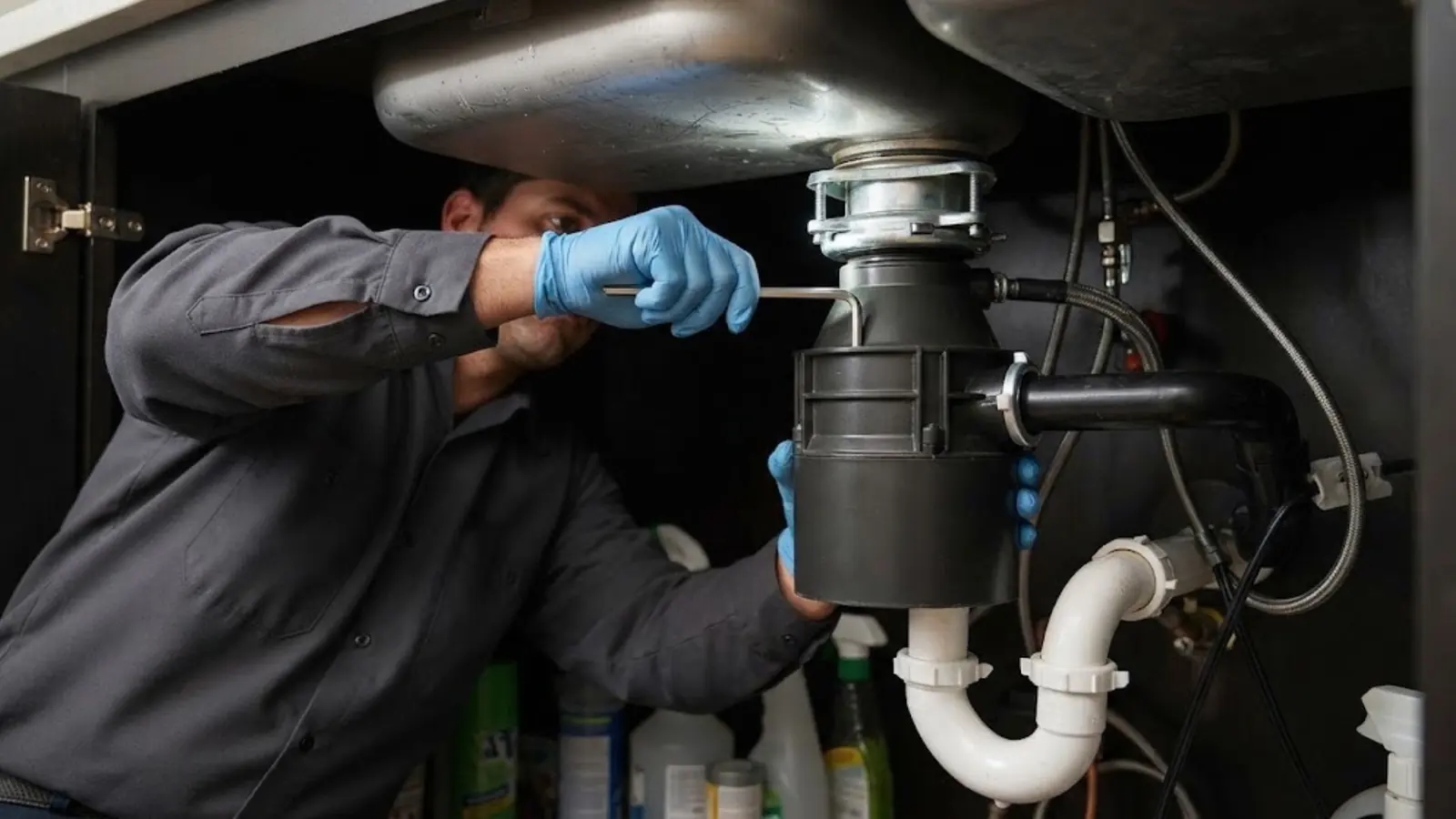
Parts under a double sink with a disposal
Knowing the names makes any repair conversation easier.
| Part | Job | Common problem |
|---|---|---|
| Basket strainer | Seals the drain opening in each bowl | Leaks at the rim from old putty |
| Disposal flange and mount | Holds the disposal under one bowl | Loose mount that drips |
| Continuous waste tube | Connects the second bowl to the disposal outlet | Loose slip joint |
| Disposal outlet and trap arm | Sends waste to the P-trap | Wrong angle or slope |
| P-trap | Holds water to block sewer gas | Leaks at slip nuts |
| Dishwasher inlet | Receives the dishwasher drain hose | Knockout plug left in place |
Layout, step by step
Start at the bowls. One bowl holds the disposal. The other bowl has a basket strainer and a tailpiece that drops to a horizontal pipe called the continuous waste. That pipe runs to the side outlet on the disposal, so both bowls share one trap.
From the disposal outlet, a short horizontal pipe runs to the P-trap and then to the wall stub. The trap arm needs a downward slope toward the wall, and the vent for the line is in the wall. A trap that sits too low or an arm that slopes the wrong way holds water and drains slowly.
Disposal or drain acting up?
Call (385) 488-1892 and we will fix the cause, not just the symptom.
Connecting the dishwasher
Dishwasher drain water must not flow back into the sink.
Remove the knockout
New disposals have a plug in the dishwasher inlet. Knock it out from the inside and fish out the plug. Skipping this step is the most common cause of a dishwasher that will not drain.
Connect the hose
Attach the dishwasher drain hose to the inlet with a clamp.
Make a high loop
Run the hose up to the underside of the countertop and secure it, then down to the inlet. The loop keeps sink water from backing into the dishwasher.
Test
Run the dishwasher and check for leaks at the hose, the inlet and the trap.
Why this matters in a Springville kitchen
Springville homes range from older houses to newer subdivisions, and the sink layouts vary just as much. Older kitchens may have two separate traps and a tee, while newer builds use a continuous waste. In winter, with a January mean low near 22 degrees Fahrenheit, grease sticks to cold pipes faster, so what goes down the disposal in December can build up sooner than in July.
If you are remodeling and moving the sink, remember that the city may require a permit when plumbing changes. The city's published information does not cover every case, so call the Building Division at 801-489-2704 to ask.
Mistakes that cause slow drains and leaks
Using two traps on one sink, one per bowl, is a common old setup that invites trouble. Another mistake is using flexible corrugated trap pieces, which collect debris in their ridges. A smooth walled trap drains better.
Over tightening plastic slip nuts can crack them, while under tightening lets them drip. Hand tight plus a quarter turn is the usual rule. Also avoid putty on rubber washers where the maker says not to use it. Read the instructions that come with your disposal.
Choosing and sizing a disposal
Disposals are rated by motor horsepower, and a larger motor handles more waste with less jamming. Continuous feed models start when you flip a switch, while batch feed models run only when the stopper is turned in place. Batch feed is safer around children but slower to use.
Check the mounting style as well. Quick lock mounts make replacement easier. Make sure the new unit lines up with the existing trap arm height, or you will need extra fittings. A mismatch between the disposal outlet and the wall stub is a common reason a simple swap turns into a bigger job. Our plumbing installation page explains the kind of plan we make for such projects.
Air gaps and local code
Some jurisdictions require an air gap, a small fitting on the countertop that breaks any direct connection between the dishwasher drain and the sink drain. Others accept a high loop. Springville's published information does not say which applies to your kitchen, so ask the Building Division at 801-489-2704 if you are remodeling.
Whichever method is used, the goal is the same: wastewater from the dishwasher must never flow backward into the dishwasher. If you ever see dirty water in the dishwasher after running the sink, check the loop first.
What not to put down the disposal
Grease, coffee grounds, eggshells in large amounts, pasta and rice, fibrous vegetable scraps and bones are poor choices. They collect in the trap and the line. Run cold water while the disposal runs and for a short time after to move scraps along.
If the disposal hums but does not spin, it is jammed. Turn off power at the switch, use the hex socket at the bottom to turn the blades back and forth and press the reset button. If it keeps jamming, see garbage disposal repair.
When to call a plumber
Call when a leak keeps returning, when both bowls back up together or when the drain smells of sewer. A trap that gurgles points to a vent problem. A backup that affects other fixtures points to the main line, covered on our drain cleaning page.
We serve Spanish Fork and Provo as well as Springville, and the sink advice is the same everywhere.
Code and permit note
The International Plumbing Code (IPC) addresses sink traps, vents and dishwasher drain connections, so a continuous waste layout is a code matter and not only a style.
Common questions
Yes in most modern setups. A continuous waste pipe connects them to one trap.
The knockout plug in the disposal inlet may still be in place. Remove it from the inside.
It is a bend that raises the dishwasher drain hose to the underside of the counter so sink water cannot flow back.
Smooth walled traps drain better. Flexible corrugated ones collect debris.
It depends on the work. Call the Building Division at 801-489-2704.